In the packaging industry, even the smallest physical property can create a huge difference in production efficiency and product quality. One such overlooked parameter is friction. The coefficient of friction between packaging films, laminates and paperboard surfaces directly affects how materials behave on high-speed machines. Too much friction can cause jamming, wrinkling and tearing, while too little friction may lead to uncontrolled slipping and misalignment. To control this critical factor, manufacturers use the Coefficient of Friction Tester.
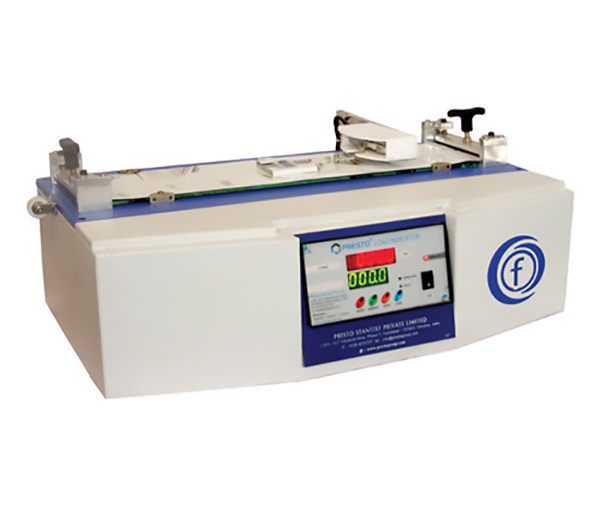
A Coefficient of Friction Tester, commonly known as a COF Tester, is a laboratory instrument designed to measure the static and kinetic friction between two material surfaces. This data helps packaging engineers maintain consistent performance of films and laminates across filling, sealing and converting processes.
Why Friction Control Matters in Packaging
Modern packaging lines operate at extremely high speeds. Films travel across rollers, guides and sealing jaws within fractions of a second. In such environments, friction must be optimized to allow smooth movement without slippage or sticking.
If friction values drift even slightly, machines may require frequent stoppages for adjustment. This results in production losses, material wastage and inconsistent package quality. By routinely testing coefficient of friction, manufacturers maintain tight control over this parameter and ensure stable machine performance.
Understanding Static and Kinetic Friction
Static friction is the resistance that must be overcome to start motion between two surfaces. Kinetic friction is the resistance encountered once the surfaces are already in motion. Both values are critical in packaging applications.
High static friction may prevent films from starting smoothly on machine rollers, causing jerks or uneven feeding. High kinetic friction may cause overheating, scratching or tearing during continuous motion. By measuring both static and kinetic friction, manufacturers gain a complete picture of material behavior.
Working Principle of a Coefficient of Friction Tester
The COF Tester operates on a simple mechanical principle. A test specimen is placed on a flat surface, and a sled of known weight is positioned on top of it. The instrument pulls the sled at a constant speed while measuring the force required to move it.
The ratio of the measured force to the normal load gives the coefficient of friction. The maximum force required to initiate movement is used to calculate static friction, while the average force required to maintain motion is used to calculate kinetic friction.
Digital COF testers automate this process, ensuring consistent pulling speed and precise force measurement.
International Standards for COF Testing
Coefficient of friction testing is performed in accordance with standards such as ASTM D1894 and ISO 8295. These standards specify sample preparation, test speed, sled weight and calculation methods.
Following these standards ensures that friction values are comparable across laboratories and accepted by customers worldwide.
Applications Across Industries
COF testers are widely used in flexible packaging, paper manufacturing, printing, textiles and plastic film production.
In flexible packaging, COF testing ensures that films move smoothly through form-fill-seal machines. In paper manufacturing, it helps control sheet feeding in printing presses. In textile industries, friction testing is used to evaluate fabric behavior during cutting and stitching.
Benefits of Using a COF Tester
One of the main benefits of friction testing is improved production stability. By maintaining consistent COF values, manufacturers reduce machine downtime and improve throughput.
Friction testing also helps identify raw material issues. Variations in resin formulation, coating composition or surface treatment can significantly affect friction. COF testing detects these variations early.
Features of Presto COF Testers
Presto COF Testers are engineered with high-precision load cells, smooth drive mechanisms and digital displays for accurate and repeatable measurements.
The machines are designed to accommodate a wide range of materials including films, laminates, papers and coated substrates. User-friendly interfaces allow operators to perform tests with minimal training.
Role in Product Development
During product development, engineers use COF testing to optimize film formulations and coatings. By adjusting additives and surface treatments, they achieve the desired balance between slip and grip.
This data-driven approach accelerates product development and ensures market-ready materials.
Maintenance and Calibration
Regular calibration of the load cell and drive system is essential for accurate friction measurement. Cleaning the sled and test surfaces prevents contamination that could skew results.
Presto provides calibration and technical support to ensure long-term reliability.
Conclusion
The Coefficient of Friction Tester is a small instrument with a big impact. It transforms friction from a hidden variable into a measurable quality parameter.
By integrating COF testing into your quality assurance process, you ensure smoother production, higher product quality and greater customer satisfaction.
Call to Action
Achieve perfect balance between slip and grip with the Presto Coefficient of Friction Tester.
Call: +91 9210 903 903
Email: [email protected]
Enquire Now: https://www.prestogroup.com/contact-us/